
Nockchain NOCK: Zero-Knowledge Proof-of-Work Blockchain

Table of Contents
Nockchain takes a different approach to Proof-of-Work by making zero-knowledge proof generation part of the network’s consensus process. Instead of relying solely on arbitrary hash calculations, Nockchain miners generate cryptographic proofs based on computations performed through NockVM. This creates the foundation for a blockchain designed around verifiable computation, while $NOCK serves as the native digital asset securing the ecosystem.
The project combines several ideas that are usually associated with different blockchain architectures. Proof-of-Work security, programmable applications, zero-knowledge proofs, and verifiable off-chain computation. Its NockApp framework is intended to let applications execute off-chain while using Nockchain as a shared settlement and verification layer.
For more insights and updates on the latest cryptocurrency trends, check out our Nifty Finances platform, your gateway to smarter financial decisions in the digital economy.
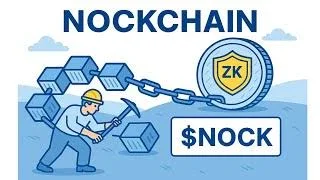
What Is Nockchain?
Nockchain is a Layer 1 blockchain built around Zero-Knowledge Proof-of-Work (ZK-PoW), a consensus design in which mining produces zero-knowledge proofs rather than relying solely on conventional hash puzzles. The project describes Nockchain as a Proof-of-Work blockchain whose miners generate proofs of computation over the NockVM while simultaneously helping secure the network. This connects the computational work performed by miners with the verification of state transitions and, more broadly, with Nockchain’s goal of creating a market for verifiable computation.
How Nockchain Mining and Block Production Work
At a basic level, Nockchain still follows the familiar structure of a Proof-of-Work blockchain. Users submit transactions, miners compete to produce the next valid block, and nodes independently verify blocks before accepting them into the chain. However, the central mining puzzle is different. Instead of repeatedly searching for a conventional hash that satisfies a target, Nockchain miners generate a zero-knowledge proof associated with a particular computational instance and candidate block.
A simplified view of the process looks like this:
- Users submit transactions for inclusion in future blocks.
- Miners construct candidate blocks and generate ZK proofs for the required computation.
- Nodes verify the resulting proofs and transaction validity.
- Valid blocks are propagated through the network and added to the chain.
- Proofpower determines the accumulated computational weight of competing chains.
This means the mining process is directly connected to proving that a specified computation was performed correctly. The network’s consensus model describes a block as containing transactions and a header that references its parent block and includes the information needed for the proof puzzle.
Proofpower and the Heaviest Chain
One of Nockchain’s key concepts is proofpower. In conventional Proof-of-Work systems, accumulated work is generally represented through the computational effort required to find qualifying hashes. Nockchain instead measures the chain’s accumulated computational work through committed proofpower.
Nodes therefore do not simply select whichever chain contains the greatest number of blocks. They follow the chain with the greatest accumulated proofpower. If two miners temporarily produce competing blocks, nodes can observe the resulting forks and continue building on the chain carrying the greater accumulated proofpower. Eventually, the heavier chain becomes canonical while transactions from discarded branches can be returned to the mempool for future inclusion.
This distinction is important because it makes computational proof generation part of Nockchain’s security model rather than treating it as an activity separate from blockchain consensus.
Blockchain Settlement Meets Verifiable Computation
Nockchain’s broader objective is to connect blockchain settlement with verifiable computation. Its whitepaper describes a model in which mining generates zero-knowledge proofs of state transitions, allowing the computational work used to secure the blockchain to also support a broader market for provable computation. Applications can execute off-chain through NockApps and submit succinct proofs to the shared base layer for verification and settlement.
This approach gives Nockchain a role beyond simply recording transactions. The project positions the base layer as infrastructure for applications where computations can be performed separately from the blockchain while their results or state transitions remain verifiable on-chain.
Nockchain as the Base Layer of the Nock Ecosystem
Nockchain serves as the base layer of the wider Nock ecosystem. Documentation describes the ecosystem as having mutually reinforcing components, with proofpower securing Nockchain and enabling NockApp as an application layer. NockApps can use Nockchain for settlement and verification while keeping computation off-chain when appropriate.
The project’s current materials therefore frame Nockchain as more than a conventional cryptocurrency network. It provides the settlement and consensus foundation upon which programmable, provable applications can be built.
How ZK-PoW Differs From Hash-Based PoW
The fundamental difference from conventional hash-based Proof-of-Work is what miners are proving through their work. In a traditional hash-based system, miners repeatedly calculate hashes until they discover one satisfying the network’s difficulty target. Nockchain instead makes the generation of a zero-knowledge proof part of the mining puzzle. The proof is tied to the candidate block and attests to the relevant computation.
Nockchain consequently presents ZK-PoW as a way to make mining work serve a second purpose: securing blockchain consensus while generating proofs that can support verifiable computation. This combination of Proof-of-Work security, zero-knowledge verification, and on-chain settlement is the foundation of Nockchain’s role within the broader Nock ecosystem.
Zero-Knowledge Proof-of-Work: How Nockchain Mining Works
Zero-Knowledge Proof-of-Work (ZK-PoW) changes the traditional Proof-of-Work mining puzzle by replacing an arbitrary hash-search process with a structured computational task that produces a zero-knowledge proof. In conventional hash-based PoW, miners repeatedly calculate hashes until they discover a value that satisfies the network’s difficulty target. Nockchain instead requires miners to generate a proof of a computation over the Nock instruction set architecture, with the resulting proof then hashed and compared against the network’s target. This means the computational work used to compete for blocks also produces a verifiable proof rather than relying entirely on discarded hash calculations.
From a Hash Puzzle to a Proof Puzzle
The Nockchain mining puzzle begins with information from the candidate block and a miner-selected nonce. The candidate block includes transactions, a reference to the previous block, and other consensus-related information. The block commitment and nonce are used to deterministically construct a puzzle subject, which consists of field elements arranged into a balanced binary tree. The miner then runs the relevant computation and generates a STARK proof demonstrating the correctness of the resulting computation.
The basic mining cycle can be summarized as:
- Assemble a candidate block from transactions and the previous block.
- Choose a nonce and derive the corresponding puzzle instance.
- Execute the block-validity computation.
- Generate a zero-knowledge STARK proof.
- Hash the proof and compare it with the current difficulty target.
- If the proof does not satisfy the target, change the nonce and repeat.
- If it satisfies the target, broadcast the candidate block for network verification.
The important distinction is that changing the nonce changes the puzzle instance itself. Nockchain’s documentation describes each nonce as producing a fresh execution trace, preventing miners from simply reusing the computational work performed for a previous attempt.
The Role of the Previous Block, Nonce, and Difficulty
The previous block provides an important anchor for the next mining attempt. A candidate block references its parent, and that block information is incorporated into the puzzle. This links the proof to a specific point in the chain rather than allowing miners to generate unrelated proofs independently of the blockchain’s current state. If another miner discovers a new heaviest block while a miner is still working, the miner must shift its effort toward the new chain tip.
The nonce provides another changing input. Miners can repeatedly select different nonce values to generate different puzzle instances until one produces a proof whose hash meets the network’s target.
Difficulty determines how demanding that final condition is. After generating a proof, Nockchain calculates a Tip5 hash of the proof and checks whether it is below the current difficulty target. A proof that satisfies this condition qualifies as a valid mining solution. If it does not, the miner starts another attempt with a new nonce.
Maintaining the Ten-Minute Block Target
Nockchain’s ZK-PoW system is designed around an approximately ten-minute target block interval. Its puzzle documentation states that the target difficulty changes every two block-weeks to maintain approximately ten-minute block times as additional mining proofpower enters the network. In other words, difficulty is not intended to remain permanently fixed while proving capacity changes.
This dynamic adjustment allows the network to respond to changes in the amount of available proving capacity. If more computational resources participate in mining, the protocol can adjust the target so that block production remains around its intended interval rather than accelerating indefinitely.
Why Proving Capacity Matters
Nockchain’s broader thesis is that proving capacity can become a valuable computational resource rather than simply being a cost associated with securing a blockchain. The project’s whitepaper describes Nockchain as a distributed market for verifiable computation, where mining generates zero-knowledge proofs of state transitions and the same underlying proving infrastructure can potentially support other useful computational workloads.
This creates a different economic framing for Proof-of-Work. Instead of treating mining computation as useful only for demonstrating expenditure, Nockchain aims to make proof generation itself economically meaningful. Its documentation describes proofpower as an emerging resource comparable in some respects to hashpower, while NockApps and other future workloads could provide additional uses for the proving infrastructure.
Nockchain’s ZK-PoW design connects mining, proof generation, and blockchain consensus in a single process. Miners compete by generating proofs, nodes verify those proofs, and the resulting proofpower contributes to the weight of the chain. The approximately ten-minute target and dynamic difficulty mechanism then help regulate block production as the network’s proving capacity evolves.
NockVM and the Technology Behind Verifiable Computation
NockVM is the virtual machine at the center of Nockchain’s approach to verifiable computation. It is designed to execute Nock programs while also providing a foundation for generating zero-knowledge proofs that demonstrate a computation was performed correctly. Rather than treating the virtual machine simply as a software execution environment, Nockchain’s architecture is designed around the idea that computation can be performed off-chain and then verified through succinct proofs. This makes NockVM an important link between the Nock programming model, NockApps, and Nockchain’s proof-based settlement layer.
A Minimal Instruction Set for ZK Proving
Nock was selected for NockVM partly because of its minimal instruction set. The NockVM research describes Nock as having 12 opcodes, considerably fewer than larger instruction sets such as RISC-V. The project’s argument is that a smaller instruction set can make the arithmetic circuits used for zero-knowledge proving less complex. Nock is also designed as a general-purpose, Turing-complete system, meaning its minimalism does not prevent it from expressing arbitrary computation.
The 12-opcode design covers fundamental operations such as tree traversal, constants, evaluation, equality, conditionals, composition, pushing values, procedure invocation, replacement, hints, and runtime extensions. Nock’s computation model is based on deterministic operations over tree-structured data, which gives the system a relatively compact formal specification.
This simplicity matters for zero-knowledge systems because the underlying computation must ultimately be represented as a circuit or equivalent proving structure. Nockchain’s research argues that reducing the number of instructions can reduce circuit complexity, making proof generation potentially more efficient than architectures built around much larger instruction sets. The project’s published research reports significantly smaller constraint sizes in its NockVM design, although practical proving performance remains an area of ongoing development.
Turning Nock Computation Into ZK Proofs
NockVM is designed to transform Nock execution traces into succinct, verifiable proofs. At a conceptual level, a computation begins with a Nock program and its input data. NockVM executes that computation, records the relevant execution trace, and generates a zero-knowledge proof that the computation followed the rules of the Nock instruction set.
A verifier does not need to reproduce every computational step to establish that the claimed execution was valid. Instead, it verifies the cryptographic proof. This is the mechanism that allows Nockchain to pursue its broader architecture of off-chain execution and on-chain verification. The project describes NockVM as a proving engine capable of making Nock computations verifiable without requiring the entire computation to be executed directly by the blockchain.
NockVM, NockApps, and Nockchain
NockVM becomes particularly important through NockApps, the application framework built around Nock. NockApp applications can maintain their own state and execute application logic outside the blockchain’s base layer. The runtime handles external operations such as networking and file access, while the Nock kernel contains the application logic that can be subjected to formal verification and proof generation.
This creates a three-part relationship:
- NockVM provides the execution and proving environment.
- NockApps use Nock-based kernels to build sovereign, composable applications.
- Nockchain provides the shared settlement and proof-verification layer.
Nockchain’s architecture therefore does not require every application computation to happen directly on-chain. Instead, NockApps can execute logic off-chain and submit proofs or commitments for verification through the base layer. This is intended to allow applications to retain their own rules while benefiting from a common proof system and settlement environment.
Current Limitations and Future Development
Despite the progress around NockVM, the technology is still being developed toward its longer-term goal of a feature-complete general-purpose ZKVM. Nockchain’s own research acknowledges several limitations. NockVM had not yet been integrated into the Nockchain transaction engine at the time of the June 2025 research publication, while efficient memory writes remained an open technical question. The project also notes that Nock is less familiar to developers than widely used architectures such as RISC-V.
The current roadmap identifies full Nock ZKVM completion as a planned Q1 2027 milestone, to deliver performant general-purpose zero-knowledge proofs for arbitrary computation. This distinction is important: the published NockVM research establishes the underlying proving architecture, but the project continues to develop the complete production system and its integration with the broader Nock ecosystem.
NockVM is the technological foundation that allows Nockchain to connect minimalist computation, zero-knowledge proving, and blockchain verification. Its compact instruction set is intended to make proving more efficient, while NockApps provide a practical application layer where computations can run outside the chain and later be verified through Nockchain’s shared proof infrastructure.
Nockchain brings together Proof-of-Work, zero-knowledge proofs, verifiable computation, and programmable applications into a single blockchain architecture. Its defining feature is ZKPoW, where mining revolves around generating cryptographic proofs rather than relying exclusively on arbitrary hashing. Around this foundation, NockVM provides the technology for verifiable computation, while NockApps are designed to execute application logic off-chain and settle verified results through Nockchain.
In the ever-evolving blockchain world, Aleph Zero (AZERO) emerges as a game-changer, seamlessly blending speed, security, and privacy. With its innovative AlephBFT consensus and integration of zero-knowledge proofs (ZKPs), Aleph Zero addresses the trilemma of scalability, decentralization, and privacy. Achieving transaction finality in just 0.9 seconds and boasting over 40 active use cases is a theoretical marvel and a practical solution for enterprises and developers alike.
The $NOCK asset provides the economic foundation of the ecosystem, with a hard-capped supply and issuance through ZKPoW. The project’s current development direction is moving beyond proving that zkPoW works toward building a broader market for verifiable computation and a programmable application ecosystem. For more insights and updates on the latest cryptocurrency trends, be sure to check out our Nifty Finances platform, your gateway to smarter financial decisions in the digital economy.
[…] blending speed, security, and privacy. With its innovative AlephBFT consensus and integration of zero-knowledge proofs (ZKPs), Aleph Zero addresses the trilemma of scalability, decentralization, and privacy. Achieving […]