
Artificial Inu AI: Onchain Memecoin & NVDA Ecosystem

Table of Contents

Artificial Inu AI is an onchain memecoin built around a distinctive connection to tokenized NVIDIA exposure. $AI is paired directly with tokenized $NVDA rather than a conventional USD trading pair. The project describes itself as an “onchain $NVDA community,” with its identity centered on GPUs, data centers, artificial intelligence, and the broader growth of computing infrastructure.
The ecosystem revolves around three core mechanics: the $AI/$NVDA pair, a Community Vault, and fee-based supply reduction. Trading activity contributes to the Vault, while fees collected in $AI are either burned or locked according to the project’s stated mechanism. The Vault currently contains tokenized assets including NVDA, MSFT, TSM, AMD, ASML, CoreWeave, and Micron. Importantly, Artificial Inu states that $AI does not represent NVIDIA equity, and holders cannot redeem assets from the Vault.
For more insights and updates on the latest cryptocurrency trends, check out our Nifty Finances platform, your gateway to smarter financial decisions in the digital economy.
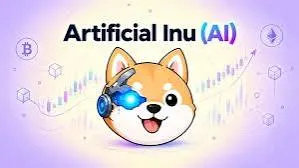
What Is Artificial Inu AI?
Artificial Inu is an onchain memecoin built around the intersection of artificial intelligence, computing, and crypto culture. Rather than using AI simply as a branding theme, the project frames its identity around the broader growth of computing infrastructure, including GPUs, data centers, and the demand for computational capacity. Its central slogan, “Long compute,” captures this positioning: Artificial Inu presents itself as a memecoin aligned with the expanding compute economy while using onchain mechanics to give that narrative a functional structure. The project describes itself as an onchain $NVDA community, with $AI at the center of its ecosystem.
The “Long Compute” Narrative
The phrase “long compute” is one of the defining ideas behind Artificial Inu. In traditional financial markets, going long generally refers to taking exposure to an asset with the expectation that its value will rise. Artificial Inu adapts that language to the computing narrative, connecting the project to GPUs, data centers, and the infrastructure supporting AI development. The project’s website specifically positions tokenized $NVDA as the other side of the $AI pair, making computing-related exposure part of the project’s onchain identity rather than simply a marketing reference.
This gives Artificial Inu a somewhat different structure from a conventional memecoin. Its cultural layer remains important—the project is explicitly a memecoin—but its ecosystem is organized around a trading pair and fee mechanism tied to tokenized $NVDA.
$AI and Tokenized $NVDA
At the center of the system is $AI, the Artificial Inu token. $AI is paired with tokenized $NVDA rather than USD. In other words, the project’s primary pairing is designed around $AI and the tokenized stock asset instead of a traditional stablecoin or fiat-denominated pair. Artificial Inu states that $AI trades against tokenized $NVDA on-chain, connecting the token’s trading environment to its broader compute narrative.
The relationship can be summarized as:
- $AI: the Artificial Inu memecoin.
- Tokenized $NVDA: the asset used on the other side of the trading pair.
- Community Vault: receives portions of trading-related fees and holds assets for the community pool.
The page states that buys generate fees paid in $NVDA, with 80% directed to the Community Vault and 20% passed to the original receiver. On sells, fees are paid in $AI, with 50% burned and 50% locked in the Vault. The website notes that the displayed amounts are illustrative examples, so these mechanics should be understood separately from any changing market figures.
The Community Vault and $AI Ecosystem
The Community Vault is an important part of how Artificial Inu connects trading activity with its ecosystem. The project’s website describes the Vault as a community pool that holds assets accumulated through the fee mechanism. Its stated purpose is not to give individual $ AI holders redeemable ownership of the underlying assets; instead, the Vault remains a separate pool belonging to the community ecosystem.
Most importantly, $AI is not NVIDIA stock and does not represent direct ownership of NVIDIA equity. Artificial Inu explicitly states that $AI is a memecoin paired with tokenized $NVDA and that holders cannot redeem assets from the Community Vault. Therefore, the presence of tokenized $NVDA within the project’s mechanics should not be interpreted as giving $AI holders ownership rights in NVIDIA.
Artificial Inu is ultimately best understood by separating its memecoin identity from its underlying mechanics. The AI and computing narrative provides the project’s cultural identity, while the $AI/$NVDA pairing, Community Vault, fee routing, burning, and locking mechanisms provide its onchain structure. Together, these components create a memecoin ecosystem built around the project’s “long compute” concept rather than a conventional USD-paired token model.

The $AI and Tokenized $NVDA Trading Pair
The $AI/$NVDA trading pair sits at the center of Artificial Inu’s onchain market structure. According to the project’s page, $AI trades against tokenized $NVDA through LONG on Robinhood Chain using Uniswap v4. Instead of using a conventional stablecoin or USD-pegged asset as the primary counterpart, Artificial Inu places tokenized $NVDA on the other side of the pair. This structure is closely tied to the project’s “long compute” identity and gives the memecoin an onchain trading model built around the broader AI and computing narrative.
Tokenized $NVDA as the Other Side of the Pair
In a typical memecoin market, traders may encounter pairs such as a token against USDC, USDT, or another widely used cryptocurrency. Artificial Inu takes a different approach by using tokenized $NVDA as the paired asset. The $NVDA as a stock token and describes $AI specifically as a memecoin paired with tokenized $NVDA. This means the tokenized asset is not merely mentioned as part of the project’s branding; it is incorporated directly into the mechanism through which $AI is traded.
This pairing gives Artificial Inu a distinctive market identity. The project combines the cultural characteristics of a memecoin with a trading environment built around an asset associated with the computing sector. As a result, the project’s “long compute” theme is reflected in the actual structure of its market rather than existing only as a slogan. The arrangement also separates Artificial Inu from memecoins whose primary market identity comes from trading against stablecoins or other general-purpose crypto assets.
Connecting $NVDA With the Compute Narrative
Artificial Inu’s use of tokenized $NVDA is closely connected to its focus on computing infrastructure. The project’s “Long compute” messaging frames the ecosystem around the broader computing economy, while $NVDA provides the tokenized asset used in its trading mechanism. NVIDIA is widely associated with GPUs and the hardware infrastructure used for demanding computational workloads, including artificial intelligence applications. Artificial Inu uses that connection as part of the narrative surrounding its ecosystem, linking the $AI token to themes such as GPUs, data centers, and the expanding demand for compute.
The important point is that this is a project-level narrative and market structure, not a guarantee that $AI will follow the performance of NVIDIA stock. Artificial Inu itself states that $AI is a memecoin paired with tokenized $NVDA and does not represent NVIDIA equity.
Onchain Settlement and Trading Mechanics
The tokenized $NVDA asset also has a practical role in Artificial Inu’s fee and settlement mechanics. The project’s “How It Works” page explains that buys involve fees paid in $NVDA, with 80% routed to the AI Community Vault and 20% passed to the original receiver. On the sell side, fees are paid in $AI, with half burned and half locked in the Vault. Artificial Inu describes these figures as illustrative splits, while the underlying mechanism connects trading activity to the project’s community pool.
The Community Vault therefore provides another connection between the two assets. Tokenized $NVDA collected through the buy-side fee flow can accumulate in the Vault, while $AI collected through sell-side fees can be burned or locked according to the project’s stated mechanics. The Vault page shows that the community pool can hold multiple tokenized assets, although its holdings can change over time.
Artificial Inu’s $AI/$NVDA pair should ultimately be understood as a specific onchain trading design that supports the project’s “long compute” memecoin identity. Tokenized $NVDA functions as the paired asset and participates in the project’s settlement and fee flows, while $AI remains the project’s memecoin token. Crucially, the presence of tokenized $NVDA does not make $AI a share of NVIDIA or establish direct equity ownership for token holders. Artificial Inu explicitly states that $AI does not represent NVIDIA equity and that holders cannot redeem assets held in the Community Vault.

How Trading Activity Supports the Artificial Inu Ecosystem
Trading activity is the main mechanism connecting the $AI market with the Artificial Inu Community Vault. The project’s mechanics page describes a fee structure in which every trade generates creator fees, with the destination of those fees depending on whether the transaction is a buy or a sell. Artificial Inu summarizes this model by describing volume as the engine behind the ecosystem: buy-side activity contributes tokenized assets to the Vault, while sell-side activity divides fees between permanently burning $AI and locking additional $AI in the Vault.
Buy-Side Fees and the Community Vault
When users buy $AI, Artificial Inu states that the associated fees are paid in tokenized $NVDA. The project’s published fee structure divides those fees into an 80% allocation for the AI Community Vault and a 20% allocation for the original receiver. This means that buy-side activity can add tokenized $NVDA to the community pool as transactions take place. The project’s mechanics page describes the Vault portion as stock tokens that are held by the community pool rather than being distributed directly to individual $AI holders.
This creates a direct connection between trading volume and the assets accumulated by the Vault. As more qualifying buy transactions occur, the stated mechanism provides a route for additional tokenized $NVDA to enter the pool. The Vault itself is publicly visible onchain, and its page currently displays tokenized NVDA alongside several other technology-related assets. Because the holdings and their market values can change, the Vault should be viewed as an evolving onchain pool rather than a fixed portfolio.
Sell-Side Fees, $AI Burns, and Locked Tokens
The sell side follows a different mechanism. Artificial Inu states that fees generated from $AI sales are paid in $AI and split equally between two outcomes. One half is permanently burned, while the other half is locked in the Community Vault and, according to the project’s mechanics page, is not sold back into the market. The stated structure therefore gives sell-side activity two separate effects: part of the fee amount is removed from the token supply through burning, while the remaining portion becomes locked within the ecosystem.
The project’s Vault page separately tracks these outcomes. At the time of the current page snapshot, it displays 8.61 million $AI as burned and another 8.61 million $AI as locked in the Vault. These figures are live on-chain metrics and can change as additional activity occurs.
How Volume Connects the Two Mechanisms
Artificial Inu’s stated model is designed around a simple relationship. Buy activity can grow the Vault’s tokenized-asset holdings, while sell activity contributes to $AI burning and locked $AI. This allows transaction activity to affect two different parts of the ecosystem simultaneously. The Vault receives assets through the project’s fee flows, while the burn mechanism permanently removes a portion of fee-generated $AI from circulation. The remaining $AI is locked rather than immediately returned to the market.
The project’s description of this model should be understood as a statement about protocol mechanics, not a prediction of market performance. A growing Vault or a declining token supply does not by itself establish that the market price of $AI will rise, nor does Artificial Inu’s fee structure guarantee a particular return for holders. The document explicitly describes $AI as a memecoin paired with tokenized $NVDA and states that it does not represent NVIDIA equity.
In this sense, trading volume provides the activity that links Artificial Inu’s main components together. Buy-side fees contribute tokenized assets to the Community Vault, while sell-side fees support the project’s stated burn-and-lock mechanism. Together, these mechanics form the on-chain framework behind Artificial Inu’s “long compute” concept, while leaving the market value of $AI subject to market conditions rather than guaranteeing a particular outcome.
Artificial Inu Community Vault
The Artificial Inu Community Vault is a central component of the project’s on-chain ecosystem, connecting trading activity with a pool of tokenized assets. Artificial Inu describes the Vault as an open, onchain community pool where fees from trades are routed according to the direction of the transaction. The project makes the Vault address publicly visible, allowing its holdings and activity to be tracked onchain. This makes the Vault an important part of Artificial Inu’s underlying mechanics rather than simply an extension of its memecoin branding.
How Trading Activity Feeds the Vault
The Community Vault is directly connected to Artificial Inu’s trading mechanism. According to the project’s “How It Works” page, $AI trades against tokenized $NVDA through LONG on Robinhood Chain using Uniswap v4. The fee structure then separates the flow depending on whether users are buying or selling $AI. On buys, fees are paid in $NVDA, with 80% routed to the AI Community Vault and 20% passed to the original receiver. This allows buy-side trading activity to contribute tokenized assets to the community pool.
The sell-side mechanism works differently. Artificial Inu states that fees on sells are paid in $AI, with 50% permanently burned and the remaining 50% locked in the Vault rather than being sold back into the market. The project describes this as a model where trading volume acts as the engine behind the ecosystem: buy-side fees can increase the Vault’s tokenized-asset holdings, while sell-side fees contribute to both the burn and locked-token balances. Artificial Inu also notes that the numerical examples displayed on its mechanics page are illustrative.
What Does the Community Vault Hold?
The Vault page currently displays seven tokenized assets, with tokenized NVIDIA ($NVDA) representing by far the largest listed holding. The other assets displayed are connected to major companies across semiconductors, computing, and technology infrastructure:
- NVDA — tokenized NVIDIA
- MSFT — tokenized Microsoft
- TSM — tokenized Taiwan Semiconductor
- AMD — tokenized Advanced Micro Devices
- ASML — tokenized ASML Holding
- CRWV — tokenized CoreWeave
- MU — tokenized Micron
The composition of these holdings fits closely with Artificial Inu’s “long compute” narrative. The Vault is not limited to $NVDA; it also displays tokenized assets associated with semiconductor manufacturing, GPUs, cloud and data-center infrastructure, and other parts of the technology ecosystem. Because the Vault is an active onchain pool, its holdings and total value can change over time. The assets displayed on the page should therefore be treated as a current snapshot rather than a permanent allocation.
Community Pool, Not Individual Ownership
An important distinction is that the Community Vault is presented as a community pool, not as a collection of assets individually owned by $AI holders. Artificial Inu explicitly states that Vault assets belong to the community pool and that $AI does not represent NVIDIA equity. The project also makes clear that holders cannot redeem assets from the Vault. Consequently, holding $AI does not give an individual holder a direct claim to the tokenized NVDA, MSFT, TSM, AMD, ASML, CRWV, or MU held by the pool.
The Community Vault ultimately connects Artificial Inu’s memecoin identity with its “long compute” concept. $AI provides the project’s core memecoin layer, while tokenized technology assets give the Vault a computing-focused composition. Through the stated fee mechanism, trading activity can add tokenized assets to the Vault, while part of the $AI generated through sell-side fees is burned and the remainder is locked. These are protocol mechanics described by Artificial Inu, not a guarantee of token price performance or future returns.
Artificial Inu AI combines memecoin culture with an unusual onchain structure centered on tokenized NVDA and the broader AI-compute narrative. Its model revolves around a direct $AI/$NVDA trading pair, a Community Vault, and fee mechanics designed to send assets into the Vault while burning or permanently locking portions of $AI. The Vault currently displays tokenized holdings across companies connected to semiconductors, computing, and technology, reinforcing the project’s “long compute” identity.
Meet Mochi MOCHI, one of Base’s most charming and talked‑about meme coins! Launched before the Base network’s main‑net debut, Mochi rides the wave of community enthusiasm with a light‑hearted brand tied to the beloved pet cat of Coinbase’s CEO — a narrative that has helped it gain recognition across crypto circles.
At the same time, an important distinction should remain clear. Artificial Inu states that $AI does not represent NVIDIA equity, and holders cannot redeem the assets held in the Community Vault. The project is therefore best understood through its documented onchain mechanics, tokenized-asset structure, and AI-compute-themed community narrative rather than as direct ownership of NVIDIA or its underlying businesses.
[…] community and engagement strategy of Mochi is a cornerstone of its identity. By blending memecoin culture, social participation, and interactive campaigns, Mochi cultivates a vibrant and inclusive […]