
KiiChain KII: Onchain FX & Payments Layer

Table of Contents
KiiChain positions blockchain technology to solve a specific financial problem: making foreign exchange and cross-border payments more accessible, programmable, and efficient. Rather than presenting itself as a general-purpose blockchain alone, KiiChain describes its network as an on-chain FX orchestration layer supporting 24/7 foreign exchange, cross-border payments, and agentic settlement. Its ecosystem combines stablecoins, smart contracts, cross-chain infrastructure, and financial applications designed particularly around emerging markets.
The KII token is the ecosystem’s native asset, used for transaction fees, staking, governance, collateral, and settlement. KiiChain also incorporates EVM compatibility, Cosmos SDK infrastructure, CometBFT consensus, and IBC connectivity to support an interoperable financial network.
For more insights and updates on the latest cryptocurrency trends, check out our Nifty Finances platform, your gateway to smarter financial decisions in the digital economy.
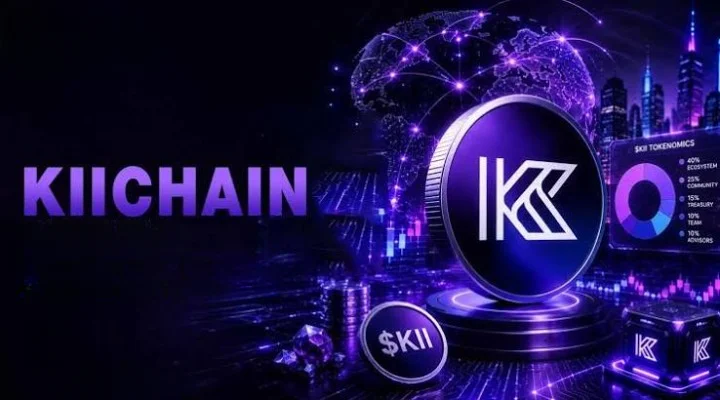
KiiChain’s Vision for Onchain FX and Borderless Finance
KiiChain is a purpose-built blockchain ecosystem focused on foreign exchange, cross-border payments, stablecoins, and real-world financial infrastructure. Rather than treating blockchain primarily as a general-purpose environment for decentralized applications, KiiChain positions its network around the practical movement and conversion of value between currencies and markets. Its stated focus includes emerging markets, where fragmented liquidity, banking-hour restrictions, and inefficient cross-border settlement can create additional friction for businesses and individuals.
At the center of this model is on-chain FX orchestration. KiiChain describes this as the automated execution of foreign-exchange swaps through smart contracts, allowing one fiat-pegged or local asset to be exchanged for another while using price information and available liquidity to complete the transaction. The objective is to move parts of the FX process onto programmable infrastructure that can operate continuously rather than being restricted to conventional banking schedules.
Onchain FX as a Core Financial Layer
Traditional foreign exchange can involve multiple financial institutions, correspondent banks, liquidity providers, settlement systems, and operating hours. A cross-border transaction may therefore require several stages before funds ultimately reach their destination.
KiiChain approaches this problem by placing FX activity closer to the blockchain settlement layer. Its architecture can source liquidity from on-chain markets while its hybrid matching engine combines centralized FX pricing with decentralized on-chain execution. KiiChain states that this allows certain FX pairs to operate continuously, including pairs whose traditional liquidity may be constrained by local banking hours.
The basic concept can be summarized as:
FX pricing → liquidity sourcing → smart-contract swap → blockchain settlement
Smart contracts provide the programmable coordination layer, while KiiChain’s surrounding infrastructure handles pricing, routing, liquidity, and settlement.
Designed for Emerging Markets
KiiChain places particular emphasis on emerging markets and local financial infrastructure. The network is designed for “last mile” integrations into local economies, with a strategic focus on markets where access to global financial infrastructure and foreign-currency liquidity can be more fragmented.
This focus is reflected in KiiChain’s support for local, non-dollar stablecoins and its broader interest in connecting global stablecoin liquidity with local currencies. The project’s documentation describes Kii as an on-chain FX layer connecting assets such as USDT and USDC with locally denominated stablecoins and markets across emerging economies.
This does not mean blockchain eliminates the need for local financial institutions. KiiChain’s own documentation notes that certain FX, payment, and on/off-ramp services depend on applicable law and, where required, locally licensed partners. Availability can therefore differ by jurisdiction.
Stablecoins as Cross-Border Settlement Assets
Stablecoins are central to KiiChain’s model because they can provide blockchain-based settlement assets linked to fiat currencies. Dollar-denominated stablecoins such as USDT and USDC can serve as globally accessible liquidity, while local-currency stablecoins can represent the receiving or spending currency in a particular market.
This creates a potential settlement path in which users or businesses do not necessarily need to move traditional bank deposits directly between every currency corridor. Instead, stablecoins can serve as programmable assets that are converted through on-chain FX infrastructure before being delivered through the relevant payment or local settlement system.
KiiChain describes its infrastructure as supporting cross-border payments, remittances, trade settlement, fiat swaps, and pay-ins and pay-outs through local stablecoins and other tokenized assets.
Bridging Traditional Finance and Blockchain Settlement
KiiChain’s approach is therefore not simply an attempt to replace traditional finance with a blockchain. Its architecture sits between conventional financial rails and blockchain-based settlement.
Traditional infrastructure remains relevant for banking relationships, local currency access, compliance, liquidity, and fiat on/off-ramps. Blockchain infrastructure provides programmable execution, transparent settlement, interoperability, and the ability to operate with digital assets around the clock.
This hybrid approach is reflected in KiiChain’s hybrid matching engine, which can combine centralized pricing and liquidity management with decentralized on-chain swaps and settlement. The goal is to connect institutional-grade FX infrastructure with blockchain-based execution rather than requiring users to choose entirely between traditional finance and decentralized systems.
KiiChain’s vision is to make FX and cross-border payments more programmable and continuously accessible by placing currency conversion and settlement closer to the blockchain layer. Its purpose-built architecture combines smart contracts, stablecoins, liquidity aggregation, interoperability, and local financial connections to address the practical challenges of moving value between markets. The result is a financial infrastructure model in which blockchain serves not merely as a payment rail, but as an on-chain coordination layer for foreign exchange and borderless finance.
KiiChain as a Layer 1 for Financial Applications
KiiChain operates as a purpose-built Layer 1 blockchain designed around foreign exchange, stablecoins, payments, and real-world asset infrastructure. Rather than building financial applications entirely on top of a general-purpose network, KiiChain provides the underlying blockchain environment where these applications can execute transactions, settle assets, and interact with custom financial modules. It describes KiiChain as an on-chain FX and settlement layer built particularly with emerging-market financial use cases in mind.
KiiChain’s Layer 1 Architecture
As a Layer 1, KiiChain provides the base network on which applications and protocols can operate. This includes the blockchain’s consensus mechanism, validator infrastructure, transaction execution, smart-contract environment, and native modules. Applications built on KiiChain therefore do not need to establish their own independent settlement network for every transaction.
This architecture is particularly relevant to financial applications because FX, payments, and asset-tokenization systems can require predictable settlement and specialized functionality. KiiChain’s documentation describes custom modules and protocols for areas including FX, real-world assets, oracles, gas abstraction, and other financial functions.
The network consequently serves as more than a generic smart-contract platform. Its Layer 1 infrastructure is designed around a particular financial environment where stablecoin settlement, cross-chain liquidity, and tokenized assets can operate together.
Cosmos SDK and CometBFT Proof of Stake
KiiChain is built using the Cosmos SDK, a modular framework for creating application-specific Proof-of-Stake blockchains. The Cosmos SDK allows developers to combine reusable blockchain modules while also creating functionality tailored to a network’s particular requirements. This modular approach gives KiiChain greater control over how financial applications and network-level features are implemented.
For consensus, KiiChain uses CometBFT, the Byzantine Fault Tolerant consensus engine used within the Cosmos ecosystem. CometBFT separates consensus from the application layer and is designed to provide fast finality and high-throughput transaction processing. KiiChain combines this consensus architecture with Proof of Stake, where validators stake tokens to participate in securing the network, and other participants can delegate tokens to validators.
KiiChain describes the architecture as capable of producing blocks in seconds and supporting fast settlement. Its repository currently lists a target of up to 12,000 transactions per second with approximately one-second block times. These figures describe the network’s stated technical capabilities rather than a guarantee of sustained real-world throughput under every workload.
Deterministic Finality for Financial Settlement
Finality is particularly important for financial applications. When users exchange currencies or settle payments, they need confidence that a confirmed transaction will not simply be reorganized moments later.
KiiChain’s CometBFT-based architecture is designed around rapid consensus and finality. This allows transactions to progress through the network’s consensus process without relying on the probabilistic confirmation model associated with some other blockchain architectures. KiiChain specifically connects this fast-finality design with use cases such as cross-border payments and FX settlement.
For an FX-focused blockchain, this can reduce the time between executing a currency conversion and considering the corresponding blockchain settlement complete.
EVM and CosmWasm Compatibility
KiiChain also combines its Cosmos-based architecture with compatibility for different smart-contract environments. Its EVM module allows developers to deploy Solidity-based smart contracts and interact with Ethereum-oriented tooling and applications. This gives developers familiar with Ethereum infrastructure a path toward building on KiiChain without abandoning the EVM development model.
At the same time, KiiChain supports CosmWasm for smart-contract functionality used by its RWA infrastructure. The Kii RWA Protocol uses CosmWasm contracts and connects tokenized assets with ERC-compatible representations. This gives the network access to both EVM-oriented development and the broader Cosmos smart-contract environment.
The combination can be summarized as:
- Cosmos SDK → modular Layer 1 foundation.
- CometBFT + Proof of Stake → consensus and network security.
- EVM → Solidity and Ethereum-compatible application development.
- CosmWasm → Rust-based smart contracts and Cosmos-native applications.
- IBC and interoperability infrastructure → communication with other blockchain ecosystems.
Why an Application-Specific Layer 1 Matters for Finance
Financial applications often have requirements that differ from those of general-purpose decentralized applications. FX platforms may prioritize fast settlement and liquidity routing, while payment systems may require predictable transaction costs and local-currency support. RWA applications can additionally require compliance mechanisms, identity checks, asset verification, and specialized token standards.
KiiChain’s application-specific architecture allows these requirements to be incorporated closer to the blockchain layer. Its documentation describes modules and infrastructure for FX, payments, tokenized real-world assets, interoperability, and financial applications rather than treating them as unrelated applications built independently.
This is the core rationale behind KiiChain as a financial Layer 1: the blockchain itself is designed around the settlement requirements of the applications it aims to support. By combining Cosmos SDK modularity, CometBFT consensus, Proof of Stake, EVM compatibility, CosmWasm, and interoperability, KiiChain provides a specialized foundation for onchain FX, stablecoin payments, and tokenized financial markets while retaining the programmability expected from modern smart-contract networks.
Stablecoins, FX Swaps, and Cross-Border Payments
KiiChain places stablecoins at the center of its onchain foreign-exchange and payment infrastructure. Its documentation describes Kii as an onchain FX layer that connects global stablecoin liquidity, including dollar-denominated assets such as USDT and USDC, with locally denominated stablecoins and markets across emerging economies. This approach is designed to connect the deep liquidity available in major dollar stablecoins with the local-currency requirements of businesses and users conducting cross-border transactions.
Dollar and Non-Dollar Stablecoins in KiiChain’s FX Infrastructure
Dollar stablecoins can provide a familiar liquidity base for international transactions, while non-dollar and local-currency stablecoins can represent the currency needed on the receiving side of a payment. This distinction is important because cross-border finance is not simply a matter of transferring dollars between wallets. Businesses often need to convert funds into the currency used by suppliers, customers, employees, or local financial markets.
KiiChain’s model therefore connects different forms of stablecoin liquidity rather than treating one stablecoin as the universal settlement asset. Its documentation specifically describes a system connecting global liquidity such as USDT and USDC with local stablecoins and markets in emerging economies. These local assets can support FX transactions, remittances, trade settlement, and payment flows.
Onchain FX Swaps Between Currencies
The blockchain provides the execution environment for onchain FX swaps, allowing one currency-denominated asset to be exchanged for another through smart-contract-based infrastructure. KiiChain’s broader FX architecture combines on-chain liquidity with centralized pricing and liquidity management through its hybrid matching engine.
This model is intended to source liquidity across different blockchain ecosystems while using centralized pricing mechanisms to hedge and rebalance positions. Instead of requiring users to manually move assets between separate networks and liquidity venues, Kii aims to coordinate these activities through a unified liquidity layer.
For users, the practical objective is straightforward: an asset held in one currency or blockchain environment can potentially be converted into another currency-denominated asset through the supported FX infrastructure. The exact availability of trading pairs and payment services depends on liquidity, jurisdiction, and the relevant service providers.
Cross-Border Settlement With Local Fiat Stablecoins
Local-currency stablecoins are particularly important to KiiChain’s emerging-market focus. A cross-border payment may begin with a globally liquid asset such as USDC, but the recipient may ultimately need a token representing a local currency. KiiChain describes its infrastructure as supporting cross-border payments, remittances, trade settlement, and pay-ins and pay-outs through local, non-dollar stablecoins and other tokenized assets.
This creates a potential settlement path such as:
Global stablecoin → on-chain FX conversion → local stablecoin → recipient or local payment rail
The blockchain can coordinate the settlement steps, while ramps and locally licensed partners may provide connections to traditional accounts where required. KiiChain notes that on- and off-ramp functionality is subject to applicable laws and licensing requirements, with availability varying by jurisdiction.
Moving Beyond Traditional Banking Hours
One of KiiChain’s stated objectives is to address the restricted operating schedules of traditional FX infrastructure. Its documentation notes that conventional FX operations can be constrained by banking hours, whereas blockchain networks can continue processing transactions outside those traditional schedules.
Kii describes its FX infrastructure as capable of providing 24/7 onchain FX trading and real-time settlement where available. Its hybrid matching engine is also designed to operate continuously on certain currency pairs even when traditional liquidity is limited to business hours.
This does not mean every financial service connected to KiiChain operates continuously or that settlement is available in every jurisdiction. Instead, the advantage comes from the underlying blockchain’s ability to process transactions continuously, while liquidity providers, payment partners, regulatory requirements, and local banking infrastructure can still determine actual availability.
Why Local-Currency Liquidity Matters
For emerging markets, access to local-currency liquidity can be just as important as access to global dollar liquidity. Businesses operating across borders may need to receive payments, pay suppliers, settle trade obligations, or manage treasury balances in local currencies. If liquidity is fragmented across different banking systems and blockchain networks, converting between those assets can introduce additional complexity.
KiiChain’s model attempts to address this fragmentation by connecting global stablecoin liquidity with local markets through an interoperable liquidity layer. Its stated use cases include FX, remittances, trade settlement, and payment finance, positioning stablecoins as programmable settlement assets rather than simply digital versions of dollars.
The result is a financial infrastructure model where stablecoins provide the settlement medium, onchain FX provides currency conversion, and local-currency liquidity connects blockchain transactions with emerging-market economies. KiiChain’s goal is to bring these components together into a continuously available financial network, while actual access remains dependent on liquidity, supported assets, local infrastructure, and applicable regulation.
KiiChain takes a focused approach to blockchain finance by putting on-chain FX, stablecoin payments, cross-border settlement, and real-world assets at the center of its ecosystem. Its Layer 1 infrastructure combines Cosmos SDK and CometBFT technology with EVM compatibility and cross-chain connectivity, while KiiChain provides the native economic infrastructure for gas, staking, governance, collateral, and settlement.
Imagine executing thousands of trades per second—for less than a cent. That’s Loopring LRC in action! Loopring is a zkRollup Layer-2 protocol built on Ethereum that packs high-speed, low-fee trading and payment capabilities into a trustless, non-custodial framework. It’s open-source, audited, and lets users keep full control of their funds—no middlemen, no worries!
The broader vision extends beyond simple token transfers. KiiChain is building toward an interconnected financial stack where FX markets, stablecoins, tokenized assets, payment rails, liquidity, and eventually AI-driven settlement can operate through programmable blockchain infrastructure. At the same time, readers should distinguish currently available services from features still marked as coming soon and consider regulatory, technical, liquidity, and digital-asset risks. KiiChain KII offers a distinctive angle on blockchain adoption: using on-chain infrastructure to connect global FX and payments with emerging-market financial activity.
[…] LRC in action! Loopring is a zkRollup Layer-2 protocol built on Ethereum that packs high-speed, low-fee trading and payment capabilities into a trustless, non-custodial framework. It’s open-source, audited, and lets users keep […]